

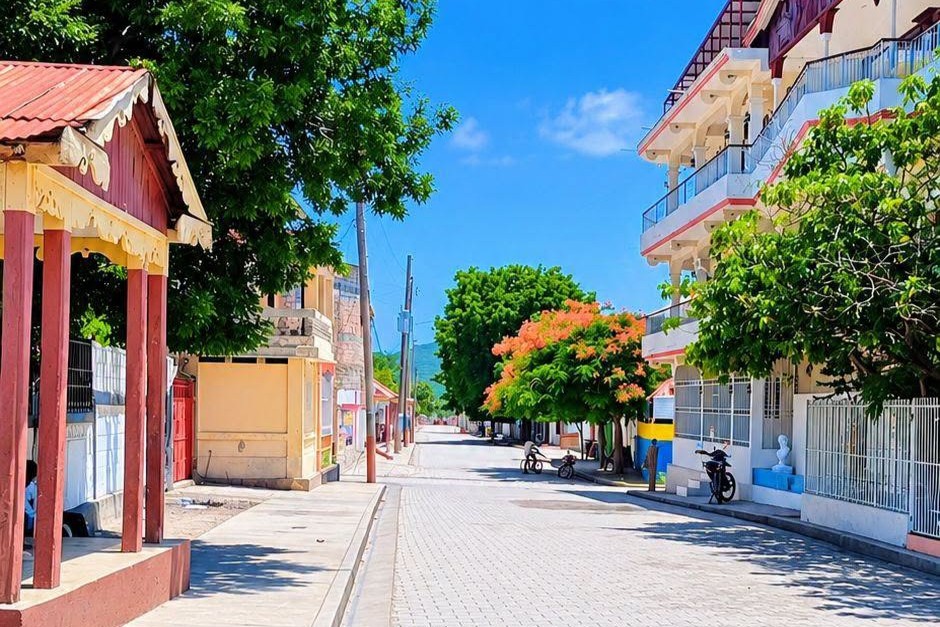
There are some news that we receive with sadness. Others with anger. And then there are those that touch us in the most intimate way, because they concern the places where we grew up, the paths we took, and the faces that accompanied our childhood. What is happening today in Marchand-Dessalines belongs to this last category.
I am from this commune. I have experienced a life that, despite its difficulties, preserved something essential which is the possibility of believing in tomorrow. Children could go to school. Families worked. It was always an immense pleasure to see, on Wednesdays and Saturdays, traders opening their shops in the market square. Farmers cultivated their lands. The future remained uncertain, but it was not entirely confiscated. Today, armed violence has profoundly disrupted this reality.
Schools are hit hard by the crisis. Important infrastructures, the oldest ones, have been vandalized or looted. Economic activities are disturbed or even completely halted, and families have had to abandon their homes. Nearly all the children in the commune find themselves far from their classrooms. Some of them, the most deprived, remain in the commune and under their innocent gaze see scenes and hear conversations that can alter their behavior in the long term. Those who have left sometimes lack the means to continue their education in the localities where they have found refuge.
Fear has settled where work, exchange, and learning should reign. It would be tempting to regard this tragedy as another manifestation of the insecurity that ravages Haiti. But this would miss a fundamental dimension of the problem. Because when a school closes under the threat of arms, it is not just a building that ceases to function. It is a space of transmission that disappears. It is a community that loses part of its ability to prepare for the future. And when this interruption prolongs, an entire generation risks paying the price. In Dessalines, the urgency is thus not only to regain security. It is also to prevent violence from destroying the future of children.
A wounded commune, a documented crisis
The situation in Dessalines is not only the result of individual testimonies or the concerns of its residents. Population displacements caused by armed violence in this part of Artibonite are now documented by international organizations. According to the ETT 101.2 report from the International Organization for Migration (IOM), the violence that occurred starting July 6, 2026, in the communes of Dessalines and Petite-Rivière resulted, as of July 23, in the displacement of approximately 6,254 people, representing 1,561 households. The displaced persons have mainly headed towards Saint-Michel-de-l'Attalaye and Gonaïves. The vast majority of them, 95%, have found refuge with host families. These figures concern the two communes and do not provide an exclusive toll for Dessalines. However, they help to gauge the scale of a crisis that far exceeds the localities directly affected.
Behind these statistics are families forced to leave their environment, parents deprived of their usual activities, and children whose education is abruptly interrupted. The consequences go beyond the displacements themselves. When a family abandons its house, it sometimes loses access to the resources that allowed it to live. When a business closes, it is income that disappears. When a school is ransacked, it is necessary not only to regain conditions of security but also to rebuild the material means of education.
These different dimensions reinforce each other. A family deprived of income can hardly finance their children's schooling in a host commune. An establishment already facing difficulties may lack resources to accommodate new students. A displaced teacher may find themselves unable to continue their professional activity. Thus, violence does not merely destroy the present. It also compromises the means by which a community could prepare for its reconstruction.
The school, the first silent victim of insecurity
In security crises, attention naturally focuses on attacks, victims, destruction, and displacements. These realities require an immediate response. But another tragedy often unfolds in relative silence, that of children deprived of schooling.
In Marchand-Dessalines, the closure of educational establishments and the difficulties in resuming classes are a major concern for families and educational authorities. The school, however, is not a secondary service that society could do without until ideal conditions return. It is a place of learning, socialization, and protection. It gives the child references, work habits, and perspectives. It helps to structure their daily life and maintain a link with the community. When it disappears permanently from their lives, the child does not only lose class hours. They lose part of their protective environment. A prolonged interruption of education can lead to educational delays, increase the risk of school dropouts, and further fragile children already exposed to violence or precarity.
This reality exceeds Dessalines. According to UNICEF, more than 1,600 schools were reported closed in Haiti during the 2024-2025 school year, affecting approximately 7,500 teachers and depriving more than 240,000 students of learning. These national data, related to the previous school year, show that the educational crisis is part of a much larger phenomenon. However, they should not obscure local situations. How many children in Dessalines are currently deprived of school? How many establishments have suffered damage? How many teachers have had to leave the commune? How many displaced families are unable to re-enroll their children elsewhere? These questions call for an updated diagnosis, conducted with educational authorities and school administrators. Because a crisis that is not sufficiently measured also risks remaining insufficiently addressed.
Displaced children suffer double punishment
The situation of children who have left Dessalines deserves particular attention. For them, displacement does not necessarily mean the end of danger or a return to normal life. Finding refuge with a relative or friend may allow them to escape an immediate threat. But hosting does not guarantee material stability, food security, or the continuation of education. Host families may themselves have limited resources. The arrival of new members increases their needs for food, housing, care, and daily expenses.
As for displaced children, they may encounter additional obstacles such as the absence of school documents, lack of supplies, registration fees, transportation difficulties, or insufficient places in host establishments. Their situation thus poses an essential question. What does it mean to save a child from violence if one cannot then restore the minimum conditions for a dignified life?
Protection cannot be limited to distancing from immediate danger. It must also include access to food, care, a safe environment, and education. It would be particularly concerning if the children of Dessalines, after losing their family and school environment, were forced to abandon their studies permanently. Internal exile should not become an educational condemnation.
This humanitarian dimension calls for mobilization that goes beyond just schools. Organizations specializing in child protection, food assistance, population displacement, and education in emergency situations have a role to play, in coordination with the relevant authorities. Displaced families should not be forgotten because they have found refuge with relatives rather than in officially identified sites.
When the state's impotence becomes a trial for society
The crisis in Dessalines inevitably raises questions of public responsibility. Protecting people and property is among the fundamental missions of the state. Ensuring access to education is also part of its responsibilities. However, when armed violence permanently prevents schools from functioning, the limits of public action become particularly visible. Local, departmental, and national authorities do not necessarily have the same competencies or means. It would therefore be reductive to indiscriminately assign them all responsibilities. But this distinction does not excuse any institution from examining what it can undertake within its area of competence.
Educational authorities can document needs, organize pedagogical continuity, and mobilize sector partners. Territorial authorities can contribute to consultation and identify community needs. The competent services of the state must, for their part, assume the responsibilities that fall to them in terms of security and protection. It is not about pretending that a meeting will solve an armed crisis. It is about refusing to allow the absence of an immediate security solution to lead to the abandonment of any thought about the educational future of children.
Between the complete reconquest of security and immobility, there are urgent needs to which a response can be sought. This response may include assessing damaged establishments, supporting teachers, integrating displaced children into schools, preparing temporary learning solutions, and mobilizing humanitarian resources. It may also require exploring possibilities for humanitarian dialogue, under the responsibility of competent actors, when such efforts can contribute to protecting populations.
But no solution should expose children, teachers, or families to further risk. The resumption of classes should not rely on mere promises of non-aggression, without a serious assessment of the risks. The goal is not to reopen schools at any cost. It is to find the conditions under which children can learn without putting their lives in danger.
Dessalines is also a historical memory that calls us
There exists, in this tragedy, a historical dimension that would be difficult to ignore. Marchand-Dessalines, the first capital of Haiti, bears the name of Jean-Jacques Dessalines, a central figure in the struggle for Haiti's independence. This memory should not be reduced to a commemorative symbol. It invites us to reflect on the concrete conditions of freedom and human dignity. Independence constituted a fundamental historical rupture. But the existence of an independent nation does not exempt successive generations from building institutions capable of protecting citizens, transmitting knowledge, and preparing for the future.
What is the use of celebrating freedom if children can no longer cross the threshold of a school? How can we convey the memory of 1804 to a generation that violence deprives of the means to understand its history and participate in the construction of its country? These questions do not only concern Dessalines. They challenge our very conception of the Republic. A society does not rebuild itself solely through its infrastructures, political institutions, or economic activities. It also rebuilds itself through the education it imparts to its children. That is why the situation in Dessalines should be considered a national interest issue. Not because this commune would have more value than other Haitian localities struck by violence, but because its drama illustrates a reality that now threatens the future of many communities. What is happening today in its schools could happen elsewhere, or extend there. And every generation deprived of education represents a human and social loss whose consequences can far exceed the duration of the immediate crisis.
Do not wait for the end of the crisis to prepare for the future
It would be illusory to believe that the situation in Dessalines can be resolved by a single initiative. Security remains a fundamental condition for any sustainable resumption of scholastic activities. But it would also be dangerous to assume that nothing can be done while the security crisis persists. A first response could involve bringing together educational authorities, representatives of establishments, parents, and humanitarian actors to establish a shared diagnosis. It would then be necessary to distinguish the needs of children remaining in the commune from those who have been displaced.
For the former, the priority would be to examine the conditions of security and realistic possibilities for educational continuity. For the latter, it would be to facilitate enrollment in host establishments and seek assistance tailored to the material difficulties of families. The mobilization of humanitarian organizations could contribute to these two objectives. Monitoring mechanisms would also be necessary to avoid commitments made remaining unfulfilled. This approach would not replace the state's obligations nor the need for a sustainable response to insecurity. However, it would recognize that education is an urgent need in its own right. Because lost school time is not an abstraction. It is measured in interrupted learning, abandoned projects, scattered teachers, and children who risk never finding their way back to class.
Do not let the future of Dessalines die
I write these lines with the pain of one who sees their native commune going through a trial whose consequences I cannot fully grasp. But I also write them with the conviction that the fate of the children of Dessalines should not remain confined to the limits of our commune. Their future concerns their families, their teachers, public authorities, and, more broadly, Haitian society. It is not about asking children to be patient while adults seek solutions to violence. It is about recognizing that they do not have the same time as we do.
A lost school year is not always easily recovered. A childhood spent in fear leaves scars. A child deprived of education for an extended period can see possibilities that should have remained open close for them. We cannot promise them that peace will return tomorrow. However, we can demand that their situation be documented, that their needs be taken into account, and that the competent institutions seek the means to preserve their right to education.
The commune of Dessalines needs security. It needs to regain its economic activities. It needs its families to live without fearing for their existence. But it also needs its children to be able to learn. Because a commune can rebuild its buildings, reopen its businesses, and repair its roads. It cannot so easily restore to a generation the years of childhood and education that violence will have taken from them.
Do not let insecurity alone decide the future of the children of Dessalines.
Notes and references
[1] International Organization for Migration (IOM), Haiti Emergency Tracking 101.2: update on displacements linked to armed violence in the communes of Dessalines and Petite-Rivière, Artibonite department, July 6-23, 2026, published on July 24, 2026. Available on the Displacement Tracking Matrix portal: https://dtm.iom.int/haiti.
[2] UNICEF, Crisis in Haiti, national data on humanitarian needs and education, consulted in September 2026. https://www.unicef.org/emergencies/crisis-haiti.
Dacely Bertrand
Telecom Engineer | Master's in IT
Professor, University of the People (California)
Professor, American University of the Caribbean (Les Cayes)
