

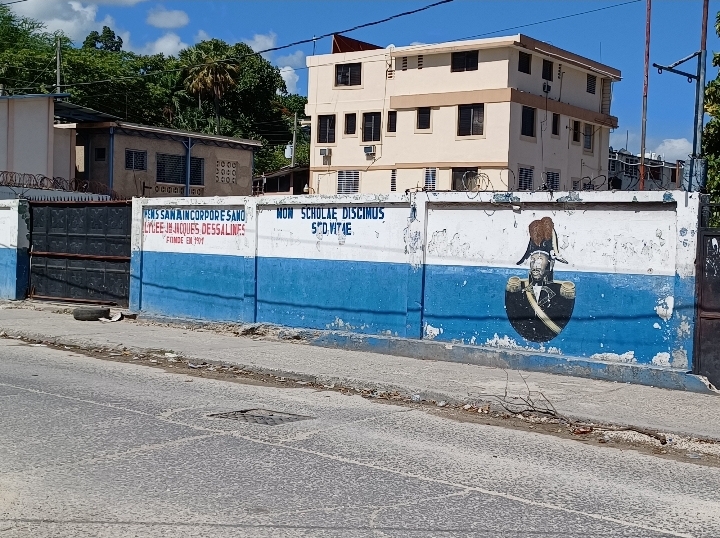
Following the intervention of soldiers from the Salvadoran mission who helped unblock certain roads in the capital, several of our compatriots, filled with nostalgia and driven by the desire to revisit the places that were once part of their daily lives, have ventured into various areas to assess the extent of the damage and observe the degradation of certain public, commercial, and private spaces.
Indeed, during this week, many of our compatriots shared shocking images of their visit to some places in Port-au-Prince. Among the numerous videos showing the dilapidated state of buildings in the downtown area, the one featuring Jean-Jacques Dessalines High School particularly caught my attention. This is for good reason, as it was within this school that I completed my secondary education until 2010, the year marked by the devastating earthquake of January 12.
I was astonished to see, through photos and videos, a school even more unrecognizable than what I had seen after the earthquake. Marked by insecurity, acts of looting, and vandalism, the space is today overrun with trees and weeds, covered in debris and the ruins of metal structures from former hangars that temporarily served as classrooms and administrative offices.
For my part, I hold memories from my years at Jean-Jacques Dessalines High School that are filled with remarkable experiences of sharing, exchanges, and debates on politics and other topics of interest with teachers and classmates, football competitions among peers, Saturday catch-up classes, recreational days, and many other activities that helped strengthen our bonds and create a family-like atmosphere, beyond just a place of learning.
More than a decade after the tragedy of January 12, 2010, leaders have struggled to rebuild a new school infrastructure on the original site of the school capable of properly welcoming its students and staff, despite promises made by various governments. According to a recently published article in "Le Nouvelliste," the institution had then been relocated to four classrooms within the premises of the Lycée National de Pétion-ville. And today, with the insecurity that has ravaged its premises on Christophe Avenue, it is far from expecting that Jean-Jacques Dessalines High School will be able to reopen its original doors in the near future.
This situation once again highlights the indifference of state authorities in managing and rehabilitating public school infrastructures. While nearly a dozen high schools in the capital have been forced to suspend their activities or relocate some of their students and staff, the cleaning and restoration work initiated by the Ministry of National Education and Vocational Training (MENFP) seems to date to be limited to Marie-Jeanne High School. It is unfortunate to see that after so many years, the other affected high schools are still waiting to find premises to resume their usual operations.
What saddens me the most is realizing how much insecurity has ravaged Jean-Jacques Dessalines High School, an emblematic institution of our educational heritage, named after the founding father of the nation. In this context, where access to quality education remains a real challenge for vulnerable families, it becomes urgent for the MENFP, state bodies, and educational sector actors to combine their efforts to rehabilitate or relocate public schools affected by the security crisis. In this regard, Jean-Jacques Dessalines High School, my alma mater, must also benefit from these initiatives to rise from its ashes.
