

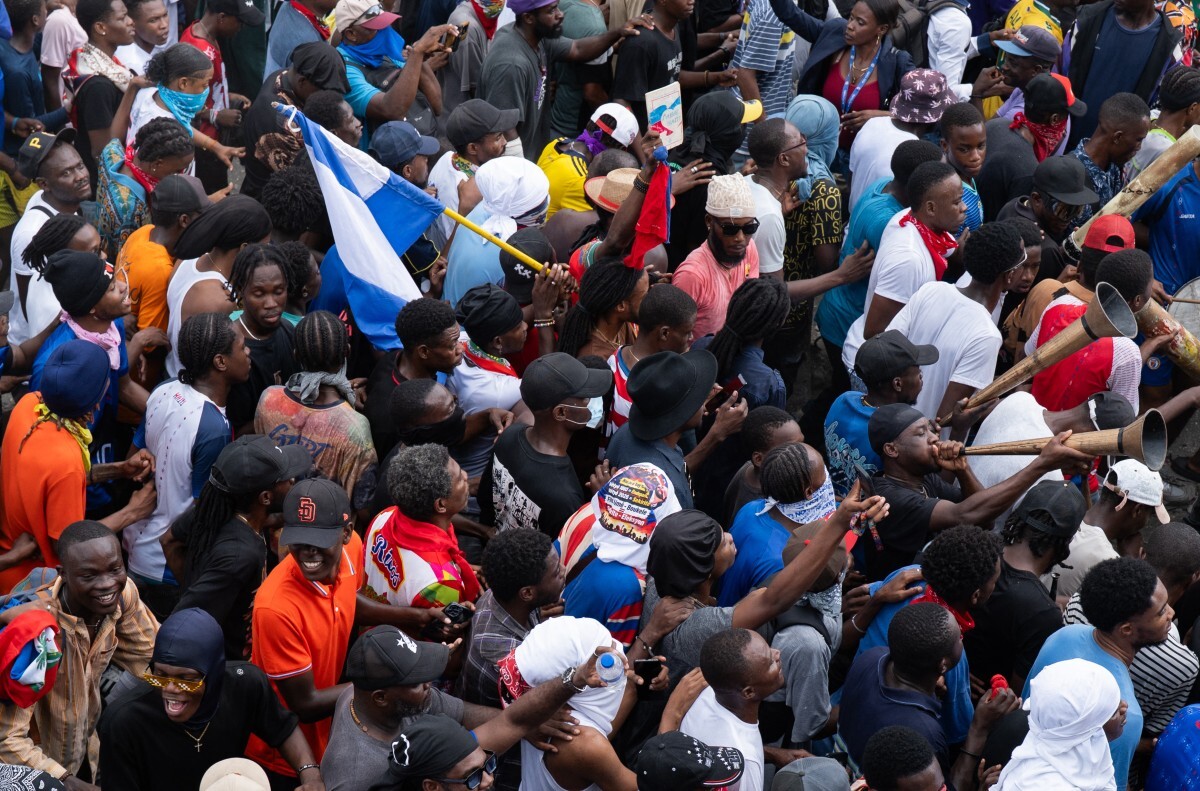
The masses have seized power in the era of the emergence of the social question, driven by struggles for access to land, work, and education. These demands have never left the popular agenda. From Dessalines, Goman, Accaau, and up to the movement of November 29, 1987.<\/p>
The uprising of slaves in 1793 and the Haitian Revolution of 1804 resulted in the birth of a new conception of humanity and the political recognition of the other. Meanwhile, the right of peoples to self-determination has established itself as a fundamental achievement. General Jean-Jacques Dessalines significantly contributed to the promotion of this international solidarity. Latin American and African peoples have thus committed to their liberation by following the traces and ideological heritage of Dessalines.<\/p>
The Haitian people adhere to an open patriotism, and not to a narrow nationalism that sees the other as a competitor. Moreover, federalism rooted in Latin American traditions has been diverted by rising imperialisms, while deglobalization represented a perspective associated with horizontal integration.<\/p>
Today, the people flood the streets of several provincial cities en masse to assert themselves as a legitimate interlocutor and a historical subject. The recurring demands for welfare and citizen participation resurface and fuel the energy of popular mobilization.<\/p>
However, armed gangs now trample on the territory of the masses and encroach upon their inalienable rights. The state disengages in the face of the shrinking of social policies, marking the retreat of the social in a neoliberal context. Repressive bodies pursue their course against the sagacity of a people eager for social services, which is perceived as a threat by the establishment<\/i>. Finally, gang violence instrumentalizes the residents of impoverished neighborhoods, subjecting them to a form of charity in exchange for their enlistment and submission.<\/p>
Solidarity marches in support of the momentum of the Salvadoran people continue to be organized, and young high school students participated in this context. Football supporters quickly transformed the scene of the match between Haiti and the United States into festivities in support of aid to El Salvador against the armed gangs that attempt to hijack the hopes of the Haitian people for well-being and the reconquest of their citizenship.<\/p>
Furthermore, the protests by students from the Faculty of Humanities for better infrastructure were repressed, even as this faculty has been besieged by gangs and its members have been displaced to become poor settlers. For their part, normalien trainees voiced their demands for remuneration and integration, still stuck in the deadlock of ongoing neoliberal policies. Finally, forcibly displaced populations in camps are on edge and limited in their right to protest for a dignified and decent relocation, and thus to fully enjoy their right to free movement and life.<\/p><\/div>
In all corners of the country, there is a resurgence of political maturation, triggered by collective actions and a refrain of change. All this has been carried by the active solidarity of our Salvadoran<\/strong> brothers, whose government invokes the feats of General Jean-Jacques Dessalines. This pioneer of the freedom of oppressed and enslaved peoples opened the way for the International of exploited classes and peoples, long before Karl Marx and the emergence of the non-aligned movement. "El Salvador, through the voice of its president, wishes to promote South-South solidarity without condescension, in recognition of this historical contribution to freedom and the conquest of the right to self-determination of peoples."<\/p> Here is the atmosphere that prevailed on the morning of November 17, 2026, on the eve of November 18, which recalls our victory against the French colonizers at Vertières in 1803. Patriotism and the values of freedom ignited, buzzing in all directions: processions here, crowds over there, junctions of groups, online collectives, and motivated individuals. They peacefully occupy the street, this natural territory of the masses. No burning tires, no skidding to report. From 9 a.m. to 3 p.m., wait-and-see attitudes gave way to mobilization that stretched to the vicinity of the Primature in Musseau. Diverted from this objective, the crowd headed towards the vicinity of the Sylvio Cator stadium, filled with enthusiasm for triumphing patriotism and solidarity among peoples. It is a momentum that is priceless for a nation wounded in its pride as a vanguard of humanity and that wants to confront the challenge of its liberation in solidarity with the Salvadoran people known for their struggle against gangs.<\/p><\/div>
