

The Post-Bukele!<\/strong><\/p> Recent attacks against gangs in the metropolitan area of Port-au-Prince and the recovery of some lost territories by Salvadoran troops have sparked a feeling of joy and relief among the population, offering a glimmer of hope.<\/p> This is evidenced by various social media posts, sudden and sporadic demonstrations in certain areas chanting the name of El Salvador's president, Nayib Bukele. There are also multiple jokes and people renaming themselves by adding Bukele's name to theirs, etc.<\/p> All this shows how grateful and warm the Haitian people can be towards those who do them good. Yes, it’s safe to say that the actions of Salvadoran troops on the ground are beneficial to the people, to the victims. And they are right to be happy and grateful.<\/p> Salvadoran troops are not the only ones acting on the ground. The UN gang suppression force, the national police, and even the Haitian population are all working to try to curb this scourge of the country. But it wouldn’t be wrong to say that before the Salvadoran president's decision to respond to the gangs following the disappearance of his four technicians, virtually nothing was happening in the fight against gang violence in Haiti. This is precisely what can be rightly called the "Bukele effect!".<\/p> The Bukele effect provides relief like taking a painkiller for persistent pain. The Bukele effect creates hope, and as René Depestre would say, a star shines on the horizon. But an effect never lasts and dissipates quickly. And if, in the meantime, no measures are taken to address the problem at the root of this pain, it often returns with greater intensity and can lead to even more disastrous consequences.<\/p> The goal is not to wish Bukele's failure. Besides, Bukele has already succeeded, if only by shaking things up and demonstrating that the gangs were not as powerful as they claimed, depending entirely on the resistance they face. We already knew this, of course, but seeing fear shift sides inspires a new feeling within the population.<\/p> At this stage of the debate, while hearts are rejoicing, and without wanting to be a party pooper, it is important to revisit some fundamental questions that remained unanswered until now. For example, the absence of a game plan! How can the Bukele effect be transformed into an instrument for a sustainable solution? How to build the post-Bukele?<\/p> The Salvadoran president has repeatedly stated that he was not acting as an invader and that his intervention, although unsolicited, was motivated by purely altruistic intentions. He claims that his goal was to make the gangs understand the consequences of their actions after they targeted four of his members. He had stated that if his four technicians were returned to him in the morning, he would leave on the same evening. If Bukele is not here to stay, what will happen when he is gone?<\/p> There was a time when, in Port-au-Prince, many believed that the death of a certain gang leader from Village-de-Dieu, Arnel Joseph, would lead to the end of violence in the country. If we go back further, we can write quite a long list of gang leaders eliminated. The breeding ground is fertile soil for the emergence of new talents, each more ferocious than the last. We are not saying that they should not be eliminated when the opportunity arises, but that it is not enough. We must also simultaneously tackle the breeding ground.<\/p> There exists a rather convenient narrative in today’s press language. El Salvador is the safest country in the region. What region are we talking about? Have we taken the time to compare it to other Latin American countries like Cuba, Costa Rica, and Uruguay, which have historically been considered countries with very low crime rates? If those countries are as safe as El Salvador, why have they not been forced to resort to the same methods as Nayib Bukele? What have they done to ensure sustainable peace in their own territories? This is an entirely different topic. For now, let’s stick to the Bukele effect.<\/p> If Bukele is directly attacking the gangs, who is addressing their supply chain? Who is taking on those who, in the private sector, the political world, and even within the state, have accompanied, protected, or weaponized them for years, rendering previous attempts to combat them ineffective?<\/p> When Bukele and his troops have left the country, will they be able to peacefully return to their old habits? Today, they are de facto; tomorrow, they will be elected and, therefore, more dangerous than ever. Consider this a warning!<\/p>
The Post-Bukele!
The Post-Bukele!Recent attacks against gangs in the metropolitan area of Port-au-Prince and the recovery of some lost territories by Salvadoran troops have sparked a feeling of joy and relief among the population, offering a glimmer of hope.
Par Samy Janvier
19 Nov 2026 — Lecture : 4 min.
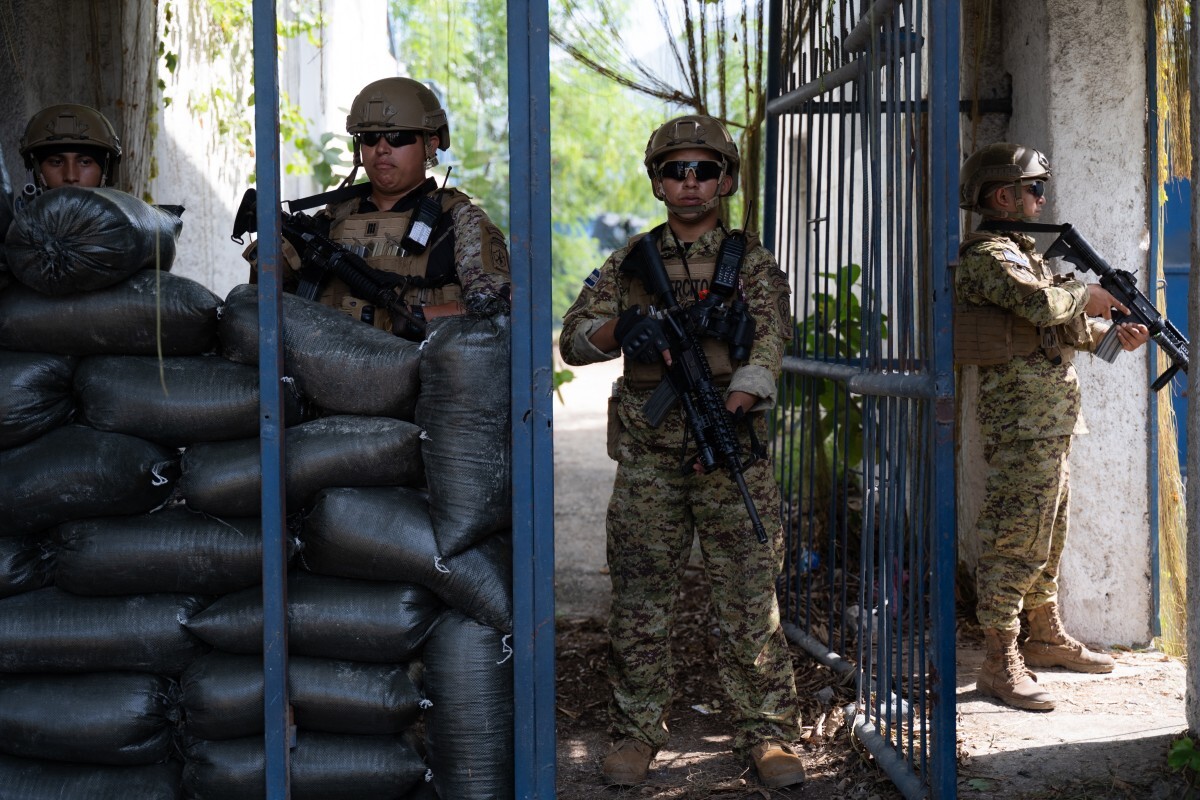
Soldats salvadoriens montant la garde aux abords du Stade Sylvio Cator
