

On Thursday, November 12, the Sylvio-Cator Stadium, occupied for more than two years by armed groups, came back under the control of security forces, with the support of Salvadoran military. This emblematic venue of Haitian football had become a symbol of the loss of control in our neighborhoods. Its reconquest deserves to be applauded. But what will happen after the armored vehicles leave? Experience obliges us to remain vigilant. In several neighborhoods of the capital, armed groups have regained a foothold after being dislodged. Liberating a neighborhood is not enough to permanently bring it back to life. Schools and hospitals must also be reopened, public services restored, the economy revitalized, and above all, trust rebuilt.<\/p>
Recapturing a word, reclaiming its meaning<\/strong><\/p>
The gangs have not only confiscated houses and neighborhoods, they have also managed to perform a symbolic hijacking. They have seized this symbol, giving their coalition a name deeply rooted in the language and collective imagination of Haitians: "viv ansanm". These two words evoke neighborhood, mutual aid, solidarity, and the capacity of different people to share a space, rules, and a common destiny. By appropriating them, the gangs have diverted an ideal of coexistence to designate a coalition that imposes fear and destroys the bonds between communities. The paradox is striking, as those who claim to "live together" have united to prevent others from doing so.<\/p>
Words shape our representation of the world. When such a fundamental expression becomes associated with terror, it weakens a part of our collective imagination. Reclaiming "viv ansanm" means refusing to let it become, for future generations, a derogatory term, an insult, or a synonym for gang.<\/strong> It is about taking away from armed groups the power to define for us what living together means and restoring the dignity of these two words in our everyday language. This reconquest also requires actions: restoring trust, respecting differences, regaining solidarity, and resolving our disagreements without violence. Reclaiming "viv ansanm" means reclaiming the right to define ourselves by what unites us rather than by those who terrorize us.<\/p>
Thirty-three registered, how many projects for Haiti?<\/strong><\/p>
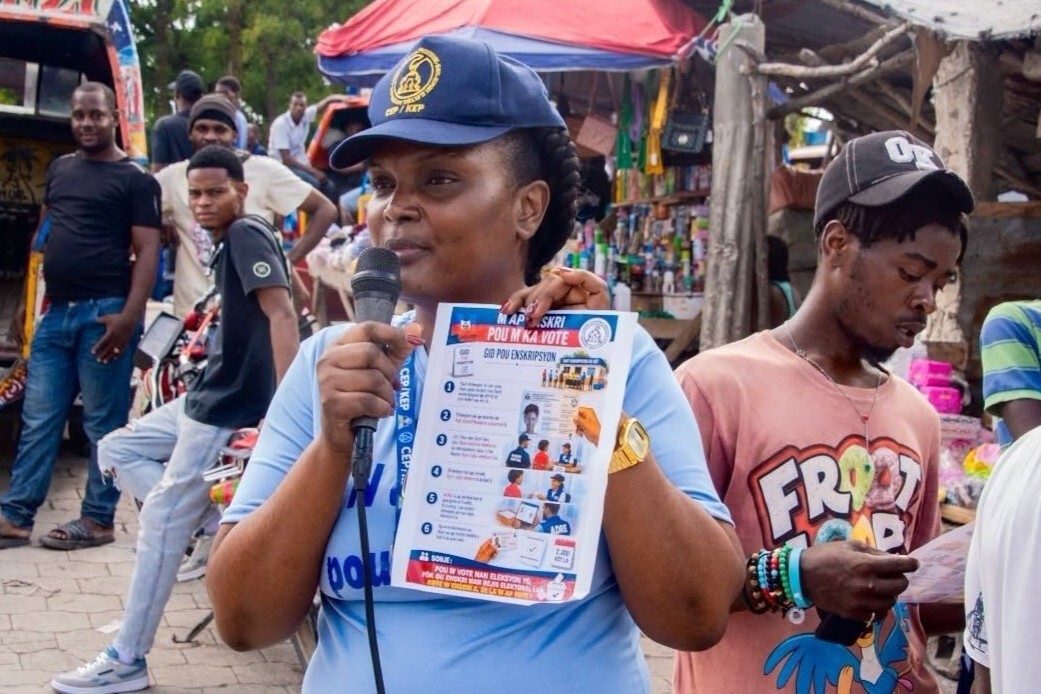
The upcoming elections will be a first test of this regained spirit. At the close of registrations on November 15, 2026, the Provisional Electoral Council (CEP) registered 33 people for the presidency, compared to 27 candidates actually in the running in 2016. The final number of approved candidacies will only be known after the verification of files. The infographic accompanying this article, "How many candidates, how many parties?", places these figures in their regional context. In the last seven presidential elections in Central America and the Dominican Republic, the median is eight candidates. In twelve English-speaking Caribbean countries, it is five parties in general elections. These indicators, coming from different systems, are not directly comparable, but they shed light on the diversity of the regional electoral offer. Certainly, the number of candidates does not solely measure the quality of a democracy. Pluralism is a wealth, and the right to run must be respected. But are there really thirty-three distinct projects to pull Haiti out of the crisis?<\/strong> Why would candidates sharing the same diagnoses, priorities, and sometimes programs wait for a potential second round to consider regrouping?<\/p>
Regrouping does not mean erasing differences or imposing unanimity. It is recognizing what we share, debating what separates us, and building compromises. It is also about restoring the true meaning of "viv ansanm". Elections should allow citizens to choose between comprehensible, feasible, and funded projects. The people deserve a clear choice.<\/strong><\/p>
The school and the youth, foundations of living together<\/strong><\/p>
Living together cannot be decreed on the eve of elections. It is learned from childhood, in the family, the neighborhood, and especially at school. In my upcoming book, One Unique School for a United Nation – School or Nothing<\/i>, I develop a conviction forged through the reforms undertaken: a deeply divided nation cannot be sustainably rebuilt on a school that is itself fragmented. A Unique School is not a uniform school.<\/strong> It guarantees every child, regardless of their social background, place of residence, or family resources, a common foundation of knowledge, values, and opportunities. In this way, it also helps to rebuild the collective imagination necessary to live in one's nation.<\/p>
The 2024-2054 Curriculum Framework reflects this ambition, notably through four subjects introduced in June 2023 and integrated into the ninth-grade fundamental exams in 2025: citizenship education, aesthetic and artistic education, physical and sports education, as well as education in technology and productive activities. The first three teach how to live together, the fourth also prepares to succeed together. Their effectiveness assumes trained teachers, applied programs, and available materials.<\/p>
The stakes are enormous in a country where more than half of the population is under 25 years old. Fertility, which has decreased from over six children per woman in the 1960s to about 2.7 today, opens the possibility of a demographic dividend. But this opportunity will only become a reality if education, training, and employment follow suit. Without prospects, part of this youth remains vulnerable to criminal recruitment.<\/p>
Reclaiming a neighborhood without providing a future for its youth risks having to reclaim it again.<\/strong><\/p>
However, in 2023, public education spending represented less than 1% of GDP, compared to a global average close to 4%. More than eight out of ten educational institutions are non-public, meaning that families bear a significant part of the funding. I therefore advocate for the inclusion in the Constitution of a minimum public funding for education of 4% of GDP<\/strong>, accompanied by increased mobilization of revenues, transparent management, and an obligation for results. This would help strengthen preschool, fundamental learning, teacher training, and technical pathways. This question deserves to be posed to the candidates: how much will they invest in transforming the school, according to what timetable, and with what resources to ensure security in all its dimensions?<\/p>
Protecting neighborhoods, rebuilding the State<\/strong><\/p>
Education and employment are essential for lasting peace, but they do not replace public force. During my last professional mission in El Salvador in 2025, my exchanges with the authorities, including the Minister of Education, reinforced my belief that lasting peace requires two inseparable pillars: a public force capable of ensuring security and an education based on the values of peace, solidarity, and 21st-century skills. As we approach November 18, the anniversary of the victory at Vertières, our history reminds us of the importance of defending the territory in the birth of the Haitian state. Yet, from 1995 to 2017, the country lived without operational national armed forces, while illicit trafficking continued to threaten its security.<\/p>
Faced with heavily armed transnational criminal organizations, the National Police cannot assume all security and defense missions on its own, and it is not its primary mission. Haiti needs a professional, well-trained army, accountable to civilian power and respectful of human rights, tasked with defending the territory, monitoring borders, and, within a strictly legal framework, supporting the police. The recovery of Sylvio-Cator Stadium underscores the utility of cooperation between the National Police, the Armed Forces of Haiti, the Task Force, and Salvadoran partners, without prejudging the exact operational role of each. But this cooperation cannot sustainably replace the development of national capacities. And when the guns fall silent, the State must return with its public services.<\/p>
Two reconquests, one nation<\/strong><\/p>
The upcoming elections will be a real test for our political elites. The paradox deserves reflection: armed groups that were long rivals have formed a coalition under the banner "Viv Ansanm", hijacking an ideal of solidarity to organize violence. Will our political leaders be able to make this ideal live through dialogue, compromise, and regrouping around common projects?<\/strong> It is not about taking gangs as a model but refusing to let them be the only ones to have made these two words a principle of regrouping, even if for the sake of destruction. The elections thus provide the opportunity to move from the proclaimed "viv ansanm" to the practiced "viv ansanm".<\/p>
Security forces can reclaim neighborhoods. It is up to society as a whole to rebuild the ties that will allow them to live there in peace. The gangs may have appropriated the name "Viv Ansanm". They must not be able to confiscate its meaning. For "viv ansanm" is not their invention: it belongs to the Haitian people. It is our common good. And it is up to us to bring it back to life.<\/strong><\/p>
