

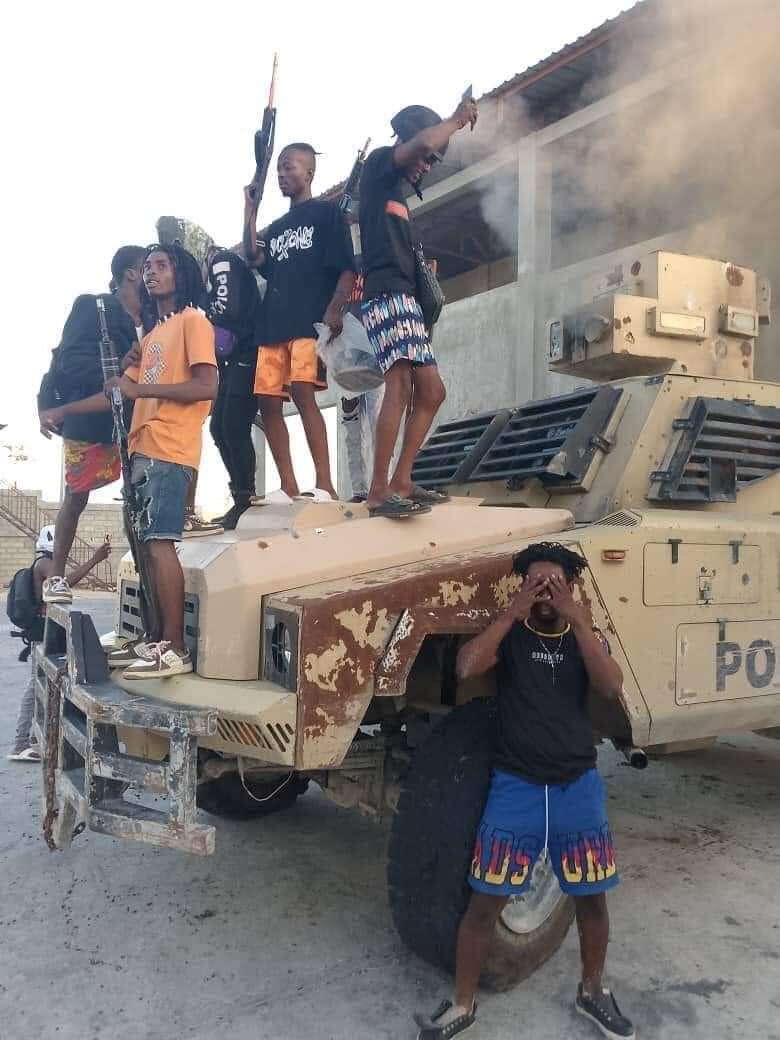
Haiti trapped by the strategic coordination of visible and invisible gangs, both national and international.<\/p>
Introduction<\/p>
The Republic of Haiti is going through one of the deepest security, political, and humanitarian crises in its contemporary history. Far from being limited to a spontaneous explosion of urban crime, the collapse of the Haitian state results from a complex mechanism.<\/p>
At the heart of this chaos lies a formidable synergy between two spheres of actors: on one hand, visible armed gangs coalitions that terrorize the population on a daily basis, and on the other, invisible networks composed of national economic and political elites, intimately linked to international financial and criminal circuits.<\/p>
This multi-layered criminal architecture has gradually transformed the territory into a lawless space, suffocating institutions and taking millions of citizens hostage.<\/p>
For the foundation of our approach, we start from the hypothesis: The security crisis in Haiti results from a synergy between visible gang coalitions that control most of Port-au-Prince and invisible networks supported by corrupt local elites as well as international arms and drug trafficking.<\/p>
This structural collapse paralyzes state institutions and triggers a severe humanitarian emergency marked by over a million displaced persons.<\/p>
I. Visible Gangs: Territorial Control and the Militarization of the Streets.<\/p>
On the ground, violence bears familiar faces and names. Once fragmented into neighborhood groups acting as sporadic armed arms during electoral campaigns or commercial conflicts, Haitian gangs have undergone a major strategic transformation in recent years. Unified within powerful coalitions, such as Viv Ansanm, they have abandoned their local rivalries to conduct coordinated offensives against symbols of the state.<\/p>
This rise in power is accompanied by unprecedented militarization. Equipped with heavy-caliber weapons, surveillance drones, and improvised armored vehicles, these groups now control almost the entirety of the capital, Port-au-Prince, as well as the main roads linking the north and south of the country. By suffocating ports, airports, and supply routes, they impose illegal taxes on the transport of goods and citizens. They thus replace public authority through terror, kidnappings for ransom, and systematic violence against civilians.<\/p>
II. Invisible Gangs: The Collusion of National Elites.<\/p>
However, the firepower and tactical coordination of street gang leaders cannot be explained without the support of "tie-wearing gangs." In the shadows of armed confrontations operates an invisible network formed by a corrupt segment of the political elite and the Haitian private sector. For decades, some economic actors and political leaders have instrumentalized armed groups to protect their business monopolies, eliminate competitors, repress social movements, or manipulate electoral processes.<\/p>
Although gang leaders have now gained considerable financial autonomy through extortion, the collusive links persist. Reports from UN experts and several international sanctions have highlighted how former government officials and influential businessmen continue to provide financing, strategic intelligence, and legal protection to these groups.<\/p>
This structural impunity ensures that the sponsors remain safe from prosecution, perpetuating a system where instability becomes an economic and political rent.<\/p>
III. International Anchoring: Arms, Drugs, and Money Laundering.<\/p>
The Haitian crisis far exceeds the island's borders. Both visible and invisible gangs are integrated into a perfectly oiled transnational logistics chain. Haiti does not produce weapons or ammunition, so the sophisticated arsenal used on the streets of Port-au-Prince comes from abroad. Illicit trafficking channels regularly transport assault rifles and ammunition, primarily from the United States, via containers concealed in commercial shipments or through clandestine maritime routes across the Caribbean.<\/p>
Meanwhile, Haiti's geographical position makes it a strategic hub for international drug trafficking. South American cartels utilize Haiti's poorly monitored coasts to transit cocaine to North America and Europe.<\/p>
Local gangs secure these shipments in exchange for weapons and cash. The revenues generated from these illegal activities are then reinjected into the legal economy or hidden abroad through sophisticated money laundering mechanisms involving shell companies and international financial circuits.<\/p>
IV. A Suffocated Nation: The Human and Institutional Impact.<\/p>
The convergence of these national and international forces has plunged Haiti into a dramatic deadlock. Institutionally, the state is bled dry: the national police, understaffed and under-equipped, struggles to contain better-armed groups, while the judicial system is largely paralyzed. Efforts to deploy multinational security support forces face considerable logistical, financial, and operational challenges against an asymmetrical enemy that is deeply rooted.<\/p>
For the civilian population, the consequences are catastrophic. More than a million people have been forced to flee their homes, creating an unprecedented internal displacement crisis. Hospitals are closing due to lack of security and supplies, schools are turning into makeshift shelters or have been abandoned, and acute food insecurity is hitting nearly half of the population. A whole generation is growing up deprived of education, healthcare, and economic prospects.<\/p>
Conclusion<\/p>
Breaking the stranglehold that confines Haiti requires far more than a simple police or military response in the streets of Port-au-Prince. As long as the fight against insecurity remains limited to visible gangs without dismantling the invisible networks that fund, arm, and protect them, the cycle of violence will regenerate. The way out of the crisis necessarily involves resolute international cooperation to dry up the arms trafficking at the source, track illicit financial flows, and uncompromisingly sanction corrupt elites.<\/p>
Only under this condition can the rule of law be reborn and restore to the Haitian people their sovereignty and dignity.<\/p>
Osnon nou fenk kare meleeeee<\/p>
Me Miguel Richard, Av.<\/p>
Doctoral candidate, specialization: diplomacy and international relations.<\/p>
General Coordinator of the International Gonâvien Network for Change (RIGC),<\/p>
Email:miguelrichardtedy@yahoo.com Sent from Yahoo Mail for iPhone<\/p>
