

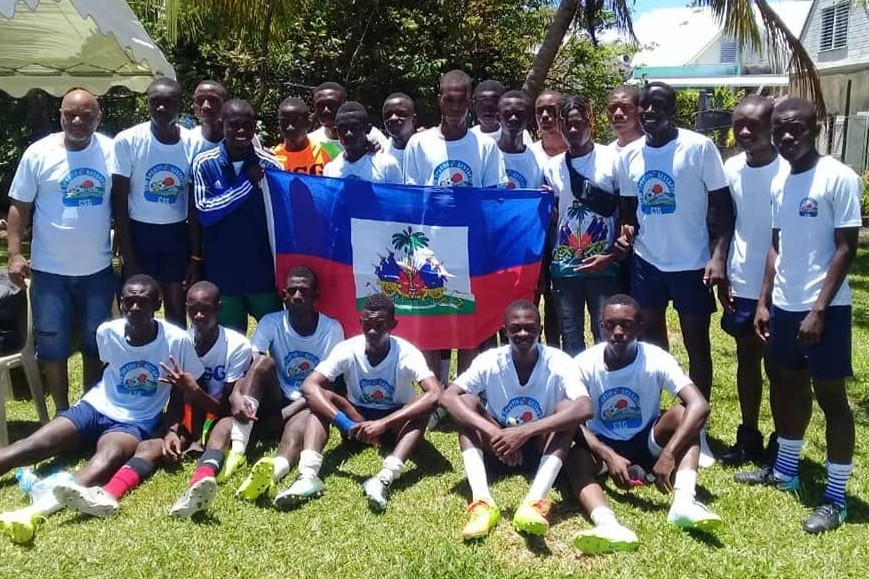
Much more than a sport, football can become a tool for education and social transformation. In a safe and supervised environment, it helps boys develop respect, responsibility, and self-control while contributing to violence prevention and child protection.<\/i><\/p>
In many communities, the football field is an important space for socialization. Young people learn to respect rules, cooperate, accept defeat, and manage their emotions. These experiences can also challenge models of masculinity that associate virility with aggressiveness, domination, and physical strength.<\/p>
According to Kesner Brunel, former coach of the Gessapop Sports Club (CSG) and current technical director of Racing FC, the responsibility of coaches goes beyond athletic performance. They contribute to forming young people capable of building respectful relationships and rejecting violence.<\/p>
Learning respect and redefining masculine strength<\/h2>
Positive masculinity is based on a concept of strength that prioritizes self-control rather than domination. A young person can learn to be competitive without humiliating their opponent, to defend their team without attacking others, and to express their frustration without resorting to violence.<\/p>
"As educators and facilitators, we also have a duty to promote positive masculinity. Being a boy or a man does not mean being violent, dominating, or imposing strength. On the contrary, true strength also manifests itself through respect, listening, self-control, the ability to acknowledge one's mistakes, and protecting the most vulnerable," explains Kesner Brunel.<\/p>
John Eliavon, a player from Tempête de Belle-Colonne de Saint-Marc, also considers football to be a school of respect and self-discipline.<\/p>
"Football teaches us to respect others, control our emotions and accept defeat. For me, a man does not need to be violent to show he is strong. True strength is when he knows how to control himself, respect others, and reject violence, both on the field and in everyday life," he asserts.<\/p>
These learnings are reflected in everyday gestures: acknowledging a foul, apologizing, or supporting a struggling teammate. They show that courage also involves mastering reactions and assuming responsibilities.<\/p>
Dr. Leslie Margel Michaud, director of World Vision International in Haiti, also emphasizes the importance of these experiences in child development.<\/p>
"The football field represents much more than a space for competition. It’s an environment where children and adolescents can learn essential values for their personal development and social integration. When a young person learns to respect the rules of the game, accept the referee's decisions, recognize their mistakes, and collaborate with teammates, they develop skills that can also influence their behavior in daily life," he explains.<\/p>
However, the transmission of these values depends on the quality of supervision and the example set by adults.<\/p>
Sports supervision, a lever for accountability<\/h2>
Coaches and club leaders play a crucial role in training young people. By tolerating insults and aggressiveness, they risk normalizing violence. Conversely, promoting fair play, listening, and peaceful conflict resolution fosters more respectful behaviors.<\/p>
Guivenson Jean Philippe, goalkeeper for Racing FC and the Haitian U20 national team, stresses this responsibility.<\/p>
"Football can play an important role in educating young people, provided that coaches and club leaders set the right example. We must understand that violence, insults, and humiliation have no place in sports. Boys must learn to respect girls, recognize their rights, and never view violence as proof of masculinity. As football players, we can also contribute to transmitting these values to the younger ones, so they grow up in an environment where respect, solidarity, and child protection are priorities," he emphasizes.<\/p>
Beyond sports skills, young people must understand that acknowledging mistakes, expressing emotions, and asking for help are not signs of weakness. These attitudes promote healthier relationships within families, schools, and communities.<\/p>
According to Dr. Michaud, sports activities can also contribute to preventing juvenile violence by providing children with spaces for growth and socialization.<\/p>
"Sport can offer young people opportunities for development, socialization, and positive expression. When they have safe spaces to engage in sports activities, children can strengthen their relationships with peers, develop self-confidence, and discover models of cooperation. However, we must avoid presenting football as a single solution to violence problems. Preventing juvenile delinquency requires a comprehensive approach that involves families, schools, community organizations, and public institutions," he specifies.<\/p>
Therefore, football serves as an educational lever, but its effects depend on support tailored to the needs of young people and their environment.<\/p>
Clubs engaged to ensure children's safety<\/h2>
Promoting positive masculinity also involves protecting children from physical and verbal violence, humiliation, discrimination, and abuse. Clubs must guarantee them a framework in which they can practice their sport without fearing for their safety.<\/p>
For Kesner Brunel, this responsibility lies with supervisors, leaders, and families.<\/p>
"Clubs, coaches, leaders, and parents must create a safe, respectful, and caring environment where every child can play football without experiencing violence, bullying, discrimination, or abuse," he insists.<\/p>
Protecting young players requires clear conduct rules, trained adults, and accessible reporting mechanisms. Children must know their rights and be aware of whom to turn to when faced with a concerning situation, without fearing retaliation.<\/p>
Sports officials must also ensure that discipline is never used to justify practices that undermine the dignity or integrity of children. Self-confidence, inclusion, and the development of psychosocial skills can only truly progress in a respectful environment.<\/p>
Gender equality, an essential learning<\/h2>
Football can contribute to deconstructing sexist attitudes and promoting relationships based on equality. Boys must understand that girls have the same rights to respect, safety, and participation.<\/p>
As Guivenson Jean Philippe points out, this awareness must be an integral part of the education of young players. Respecting boundaries, choices, and the physical integrity of others is a crucial element in the prevention of gender-based violence (GBV).<\/p>
Dr. Michaud emphasizes the importance of dissociating strength from domination.<\/p>
"Football provides an interesting opportunity to teach boys that strength should not be confused with violence and that authority should never be based on intimidation. In an appropriate educational setting, sports activities can promote self-control, empathy, respect for differences, and the ability to resolve disagreements without resorting to aggressiveness. A boy must understand that he can be brave without humiliating others, competitive without cheating, and determined without becoming violent," he explains.<\/p>
These principles must translate into interactions on the field as well as in daily life. They contribute to fighting stereotypes that present bullying and domination as signs of virility.<\/p>
Beyond sports, a collective commitment against violence<\/h2>
In Haiti, the persistence of gender-based violence reinforces the need to educate boys to respect girls and to promote equality. According to data from the United Nations cited in this report, over 5,500 cases of sexual violence against women and girls were recorded in the first half of 2026, accounting for nearly 70% of the total recorded throughout 2025. These figures highlight the urgency of strengthening prevention initiatives and promoting respectful behaviors that reject violence from a young age.<\/p>
In this regard, World Vision International in Haiti contributes to awareness-raising efforts among young people and communities regarding GBV prevention and child protection. Through its community initiatives, the organization particularly encourages questioning stereotypes related to masculinity, recognizing girls' rights, and adopting non-violent behaviors.<\/p>
To achieve sustainable results, these actions must be part of a collective dynamic involving sports clubs, families, schools, child protection organizations, and public institutions. Sport can enhance educational and community efforts, but it cannot, by itself, solve violence problems.<\/p>
The goal is thus to make the football field a secure space where every child can thrive, learn to assume their responsibilities, and respect the rights and dignity of others.<\/p>
Training a good player means teaching him to control the ball. Training a responsible young man also means teaching him to control his emotions, to respect girls, and to reject any form of violence. The true victory of educational football is measured by its ability to contribute to the emergence of a more respectful, more supportive, and more responsible generation towards others.<\/p>
Carlos Perez Valdano SYLVEUS<\/strong><\/p> Journalist, general director of Reality Times<\/i>, sustainable development specialist, photographer, and massage therapist.<\/p>
