

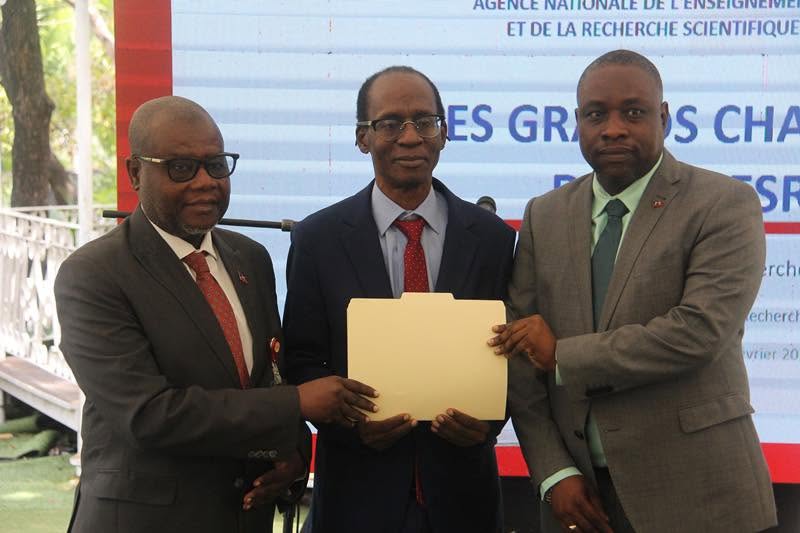
Almost all scientific articles mentioning a Haitian address are co-authored with foreign researchers. Should this be a cause for celebration or concern? A chapter from the ANESRS white paper, which addresses the conditions of research in Haiti, urges us to move beyond this dilemma and proposes concrete avenues to allow Haitian researchers to choose their own questions, to be recognized for their work, and to share their knowledge with society.
A figure that raises questions
Imagine a hundred scientific articles published in international journals, each signed by at least one person working in Haiti. According to the UNESCO report on science, around ninety-five of these articles, between 2017 and 2019, also included foreign authors. Nearly eighty-seven dealt with health. And, relative to the population, the country produced barely nine indexed articles per million inhabitants.
These figures can be interpreted in two ways. One might see them as evidence of Haitian research being well integrated into international networks, capable of attracting partners and publishing in recognized journals. But one might also perceive a certain vulnerability: if almost no publication occurs without a foreign partner, who decides the topics? Who analyzes the results? And who receives the recognition?
Chapter 9 of the white paper, published on the occasion of the first anniversary of the Council of Higher Education and Scientific Research (CESRS) of the National Agency for Higher Education and Scientific Research (ANESRS), addresses these very questions. What makes it unique is a simple conviction: to advance research in Haiti, it is not enough to increase funding. It is also necessary to change how it is valued.
Researchers without time to research
Let’s begin with the material conditions, which form the foundation of everything. The Haitian university landscape has evolved considerably: in 2018, the country had 138 recognized higher education institutions, a number that rose to 190 in 2026, of which nine out of ten are private. This expansion responds to a strong demand from youth. However, it has not been accompanied by an equivalent development of research.
In many institutions, the teacher is paid by the hour of classes. To live decently, they often work at two, three, or even four different institutions. Between commuting, grading assignments, and teaching, they have little time to read, conduct research, or write. Research is neither part of their schedule nor part of their remuneration. It is done in the evenings, on weekends, or sometimes not at all.
National funding also remains very limited. International organizations recommend dedicating at least 1% of gross domestic product to research and development. In Haiti, available data show it is well below 0.1%. Added to this are libraries and laboratories destroyed by the 2010 earthquake, power outages, high costs of accessing scientific journals, and, for several years, insecurity that sometimes complicates access to campuses or research sites.
In this context, it is not surprising that many researchers choose to collaborate with foreign partners. These collaborations have often proven valuable: they have helped train competent Haitian scientists, keep laboratories operational, and produce useful knowledge, particularly in public health. The chapter does not criticize them. It raises another question: under what conditions does cooperation strengthen Haitian capacities, and when does it, on the contrary, keep them in a state of dependence?
In figures: research in Haiti
| Indicator | Value |
|---|---|
| Recognized higher education institutions (2026) | 190, of which 90% are private |
| Universities authorized to award doctorates (since 2025) | 4 (UEH, ISTEAH, UniQ, INUFOCAD) |
| Indexed articles per million inhabitants (2019) | Around 9 |
| Percentage of articles co-signed with foreign authors (2017-2019) | About 95% |
| Percentage of articles in health sciences (2017-2019) | About 87% |
| Research expenditure relative to GDP | Significantly below 0.1% |
Sources: UNESCO (2021); Vincent and Dona (2026a, 2026b).
Epistemic dependence: what are we talking about?
This chapter employs an academic term that deserves clarification: epistemic dependence. The word “epistemic” comes from the Greek epistêmê, meaning knowledge. Being in a state of epistemic dependence means not having total control over one's own knowledge production: not being able to freely choose one's questions, having to rely on categories conceived elsewhere, or depending on criteria set by others to gain recognition.
An example helps to better grasp the situation. Imagine a foreign team arriving in Haiti with a pre-elaborated project, hiring Haitian colleagues to organize interviews and recruit participants, and then leaving to analyze the data and publish in English. Haitian researchers are, at best, somewhere in the middle of the author list. This phenomenon has a name in the international literature: parachute research. Local researchers play the role of intermediaries but not that of genuine thinkers.
The chapter is careful not to generalize. Not all collaborations function the same way, and some inequalities also exist within Haitian institutions themselves. However, certain elements deserve attention. A study published in 2025, covering a century of research on neglected tropical diseases in Haiti, shows that the majority of work has been conducted by foreign researchers, with limited Haitian participation among the authors. Another notable point is that key sectors for the future of the country, such as agriculture, water, education, or history, are underrepresented in publications, as available funding has primarily been directed towards health.
This debate is not new. As early as the 1990s, the Beninese philosopher Paulin Hountondji spoke of an extraverted African science, more oriented towards the expectations of Northern readers than towards the needs of African societies. In Haiti itself, the anthropologist Michel-Rolph Trouillot demonstrated in Silencing the Past how the Haitian Revolution has long been rendered inconceivable by Western historians. Jean Casimir has proposed a reading of Haitian history based on the knowledge of peasants. These thinkers emphasize an essential point: Haitian researchers do not merely provide data; they are also capable of producing theories that transform the way the world understands itself.
