

National silence, electoral ambition, and republican duty towards the Centre department...
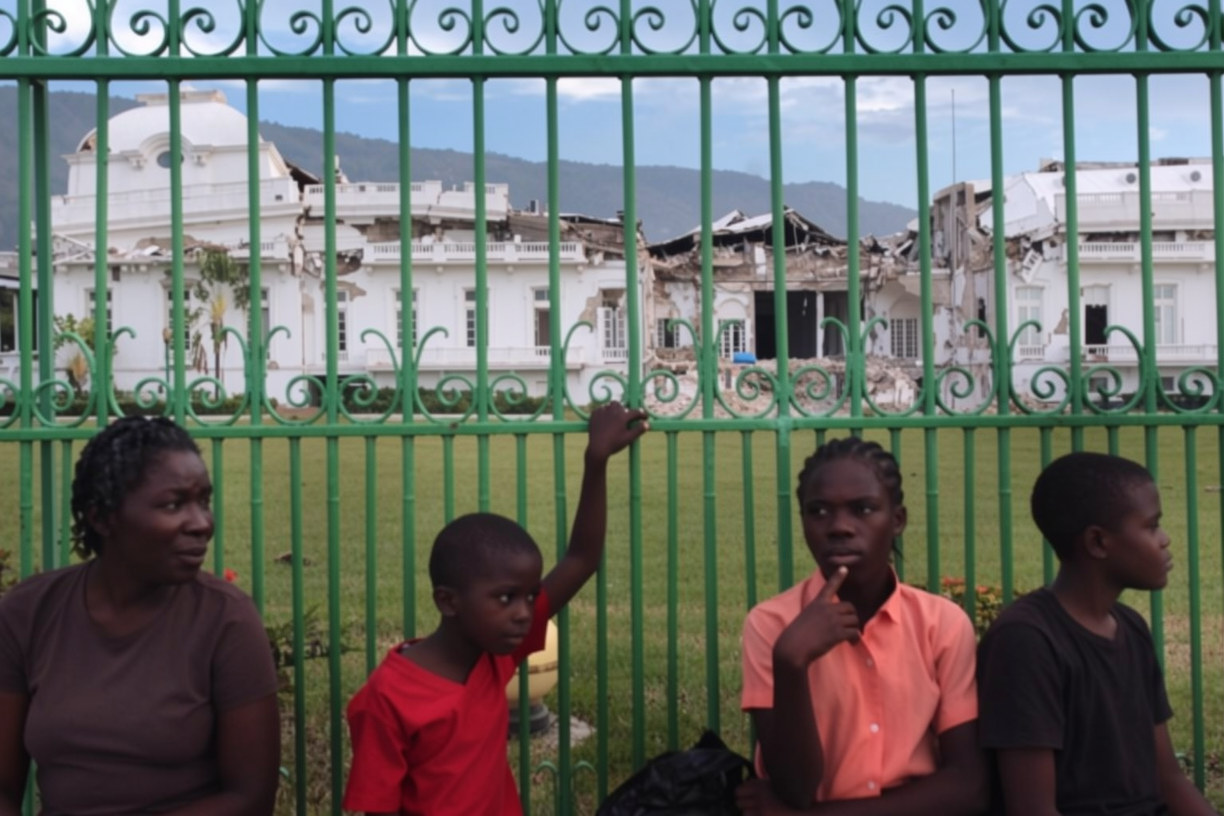
The country is sinking into fear, hunger, and displacement; yet, electoral ambitions resume their course. Candidates are registering, machines are calculating, strategies are deploying towards a single horizon: to be elected. This energy could serve the Republic. It becomes indecent when it is not accompanied by a firm word on the affected municipalities, the families thrown onto the roads, and the citizens forced to sleep under open skies.
Today, there is a national silence on the security situation in Mirebalais and Saut-d'Eau. This is not to say that no one is talking about it: residents are testifying, humanitarian organizations are documenting, local voices are alerting. The silence is political. It is the absence of lasting outrage, of a national debate placing these municipalities at the center of the campaign, and of public commitments commensurate with the disaster. Registration forms circulate more easily than responses for the displaced.
An election cannot replace conscience
The electoral calendar itself reflects an unstable process. The CEP had initially set October 2 as the deadline for candidate registration; a new extension was later reported, with the first round date officially remaining December 13, 2026 [1]. The CEP's table already shows candidacies in the Centre department, notably for Mirebalais and Saut-d'Eau [2]. These figures say nothing of the intimate intentions of each candidate. Nevertheless, they legitimize a very simple question: what is being done, amid this race, for those who have lost their homes, their bearings, and sometimes even their place in the community?
The danger is to confuse procedure with democracy. An administrative registration opens a candidacy; it does not demonstrate responsibility or legitimacy. An election does not purify silence, does not transform indifference into public service, and does not free a citizen who votes under threat, hunger, displacement, or exclusion. When one walks towards the polls without looking at those who have lost their roofs, one takes the means—gaining power—for an end that would justify itself.
That candidates from the Centre present themselves is not the problem. That they do so without making the security of Mirebalais and Saut-d’Eau, the fate of the displaced, and the welcome of families a public priority, that is the problem. The silence of a contender can become a political position: it signals what they deem worthy of attention and what they feel can be left out of the picture. A candidacy that demands trust without listening to the victims of the crisis fails in its foremost duty: to make visible the people on whose behalf it claims to speak.
The Centre, an inland country and displaced people
On March 31, 2025, armed groups launched a coordinated attack against Mirebalais. In a report published on May 16, UNICEF stated that more than 50,000 people, including 27,000 children, had been displaced in the Centre department; over 12,500 were in nearly a hundred spontaneous sites [3]. Schools were used as shelters; access to drinking water, healthcare, and education was severely disrupted. These figures describe a situation documented at that time, not an updated count to the day. But they give a measure of the disruption caused and the extent of the public duty that follows.
In every number, there is a body searching for ground to lie on. Men and women are dying of hunger, spending the night under a sky that no longer belongs to them, while their children learn to confuse school with exile. Other displaced persons report suffering daily insults and humiliations in some host municipalities. We must listen to these testimonies and verify them, without indiscriminately condemning host communities: they often lack resources themselves and cannot bear the cost of public abandonment alone. But the humiliation of a displaced person does not become less serious because the one who welcomes them is poor in turn. It is the responsibility of the State and elected officials to prevent scarcity from transforming solidarity into resentment.
Political philosophy offers a demanding criterion here. John Rawls proposes imagining principles of justice chosen behind a "veil of ignorance": no one knows if they will be born powerful or poor, a candidate or displaced, protected or forced to seek shelter. This intellectual experience obliges us to judge institutions without favoring one’s current position. Applied to the Centre campaign, it poses a biting question: would we accept rules, priorities, and public action that leave the most vulnerable hungry, insulted, or outside, if we were unaware that we would be among the elected or the exiled? For Rawls, fundamental liberties must be equal, and inequalities are only justifiable if they genuinely improve the situation of the less privileged [4].
This perspective condemns a politics that measures its success only by the number of candidacies, rallies, or coveted seats. It demands commitments that change the lives of the most exposed individuals: dignified accommodation, food assistance, access to healthcare and education, protection against arbitrary expulsions, legal listening, psychosocial support, and preparation for voluntary and safe return when conditions allow. Justice does not merely include the displaced in a program statement; it requires their interests to weigh in decisions and in the allocation of resources.
Habermas: giving voice to the absent
For Jürgen Habermas, democratic legitimacy does not come solely from the result of a vote. It also depends on the free and inclusive formation of political will: those concerned must be able to participate in the debate, contest decisions, and make their reasons heard. The voice of civil society must be able to circulate to institutions and weigh on laws as well as public policies [5]. If the displaced cannot participate in public life, if their testimonies remain confined to camps and reports, while candidates speak among themselves about posts and deadlines, deliberation is amputated of part of the people.
The national silence then becomes a two-tier exclusion. First, insecurity drives residents from their homes and deprives them of essential services. Second, the political space treats them as passive beneficiaries—or forgets them—rather than recognizing them as citizens capable of articulating what happens to them and what needs to change. Habermas invites us to measure democracy by the quality of this circulation of speech: a decision is not truly common if those who suffer its consequences have never been able to discuss it.
The campaign should therefore be more than a showcase. Candidates from Mirebalais and Saut-d’Eau should reach out to the displaced and host families, publish their proposals, specify the budgets and responsibilities they will defend, and then accept exchanges where they can be held accountable. The media, parties, national elected officials, professional organizations, and civil society should keep the question at the heart of public space. It is not about turning a tragedy into a propaganda argument; it is about restoring to affected people their place in decision-making.
Republican freedom: deciding without fear
The Haitian Constitution of 1987 provides a national basis for this requirement. Its preamble commits the Republic to guarantee life and freedom, establish a socially just nation, protect pluralism and alternation, combat discrimination between urban and rural areas, and base government on fundamental liberties, social peace, fairness, consultation, and the participation of all the population in major decisions [6]. These principles are not mere ceremonial decorations. They judge present actions.
Republican freedom means that citizens and officials can form and express their choices without threat, coercion, or undue pressure. It does not mean that power is freed from any rule: decisions must remain subject to the Constitution, the law, public oversight, and the general interest. A vote obtained in fear is not free; a debate where the displaced are inaudible is not fully public; an authority that decides without responding to the population betrays the sovereignty it invokes.
Liberty, equality, fraternity: these words regain their strength when they become concrete obligations. Freedom, so that violence does not assign citizens to exile or dictate their vote. Equality, so that the citizenship of a family from Mirebalais is not diminished by the loss of its roof or the disdain suffered in a host country. Fraternity, so that misery does not pit the poor against the poor and so that host municipalities are not abandoned along with the displaced. The Republic must protect everyone and be accountable to all.
The urgency of accountability
To the candidates from the Centre, this is not the time for circumstantial indignation or campaign poetry. It is time for verifiable actions. How many displaced families have you listened to? What measures will you defend to protect them from hunger, bad weather, and insults? How will you help host municipalities share this burden? What complaint and oversight mechanisms will you support? What will you do to ensure that the displaced can register, vote, and participate safely? A precise answer to these questions will weigh more than a promise of power.
At the national level, candidates and politicians must stop treating security as just another item and the displaced as a humanitarian backdrop. The government must publish regular information about protection measures, available services, the needs of host municipalities, and the preparation for accessible elections. The CEP, parties, and public institutions must explain how the exercise of rights will be guaranteed to those whose lives have been upended by violence. Civil society and the media also have the responsibility to refuse to allow the campaign to chase this crisis from the common space.
The people ask not for candidates to possess a magic wand. They ask for them not to morally abscond from the country they wish to govern. If ambitions are teleological, entirely absorbed by the electoral end, they become incapable of judging the means, the silences, and the lives sacrificed in their wake. Rawls reminds us to look at society from the position of the least advantaged; Habermas, to listen to those excluded by procedures; the Haitian Constitution, to guarantee the rights and participation of all. Together, these requirements make compassion a political duty and accountability a condition for legitimacy.
One can hear, in the night shelters, the light sound of rain falling on tarpaulins and on lives in suspension. The campaign, on the other hand, makes a great noise. Let that noise not drown out the calls from Mirebalais and Saut-d’Eau. Let us stop rushing to the polls as if the election were the entire country. Democracy does not start at the voting booth: it begins when no citizen is abandoned outside the circle of speech, protection, and dignity.
References
[1] Associated Press, "Haiti’s electoral council drops rule targeting candidates sanctioned by foreign countries," October 9, 2026. https://apnews.com/article/haiti-elections-sanctions-cep-bank-brh-f230a464fd798b13171ce894ebeca66a
[2] Provisional electoral council, Candidate registration statistics, table consulted on October 12, 2026. https://tableau.cephaiti.ht/
[3] UNICEF Haiti, "A new crisis unfolds in Haiti’s Centre department," May 16, 2025. https://www.unicef.org/haiti/en/stories/new-crisis-unfolds-haitis-centre-department
[4] Stanford Encyclopedia of Philosophy, "Original Position," John Rawls and the veil of ignorance. https://plato.stanford.edu/archives/spr2026/entries/original-position/
[5] Stanford Encyclopedia of Philosophy, "Jürgen Habermas," deliberative democracy and legitimacy. https://plato.stanford.edu/entries/habermas/
[6] Constitution of the Republic of Haiti, March 29, 1987, Preamble, text reproduced by IFES. https://www.ifes.org/sites/default/files/migrate/con00097.pdf
