

What should we do every morning to not lose our humanity? I did not expect the 36th São Paulo Biennial to evoke such a profound question within me. I went to visit the Berlin edition of this Biennial as one visits any exhibition, to see, discover, and feel a little. But I emerged with the feeling of being challenged. The flags lining the path of the House of World Cultures should have warned me. The verses inscribed on each propose a way of living that is both practical and radical. One of them carries the words of René Depestre: “My joy is to know that you are me and that I am strongly you.” In response to this Haitian voice is that of painter and writer Frankétienne, whose works, presented in the São Paulo edition, are filled with faces and whirlwinds where humanity as a whole seems to struggle.<\/p>
Entitled Not All Travellers Walk Roads: Of Humanity as Practice, the 36th São Paulo Biennial included 125 individual and collective artistic participations. Its Berlin edition, uniting the works of more than thirty artists and collectives, extends this invitation to practice humanity. To conjugate it as if it were a verb. To conjugate it day by day as if it were never acquired. To conjugate it with all people, you, me, us, the other, not forgetting non-human living beings, as if its grammar knew no borders.<\/p>
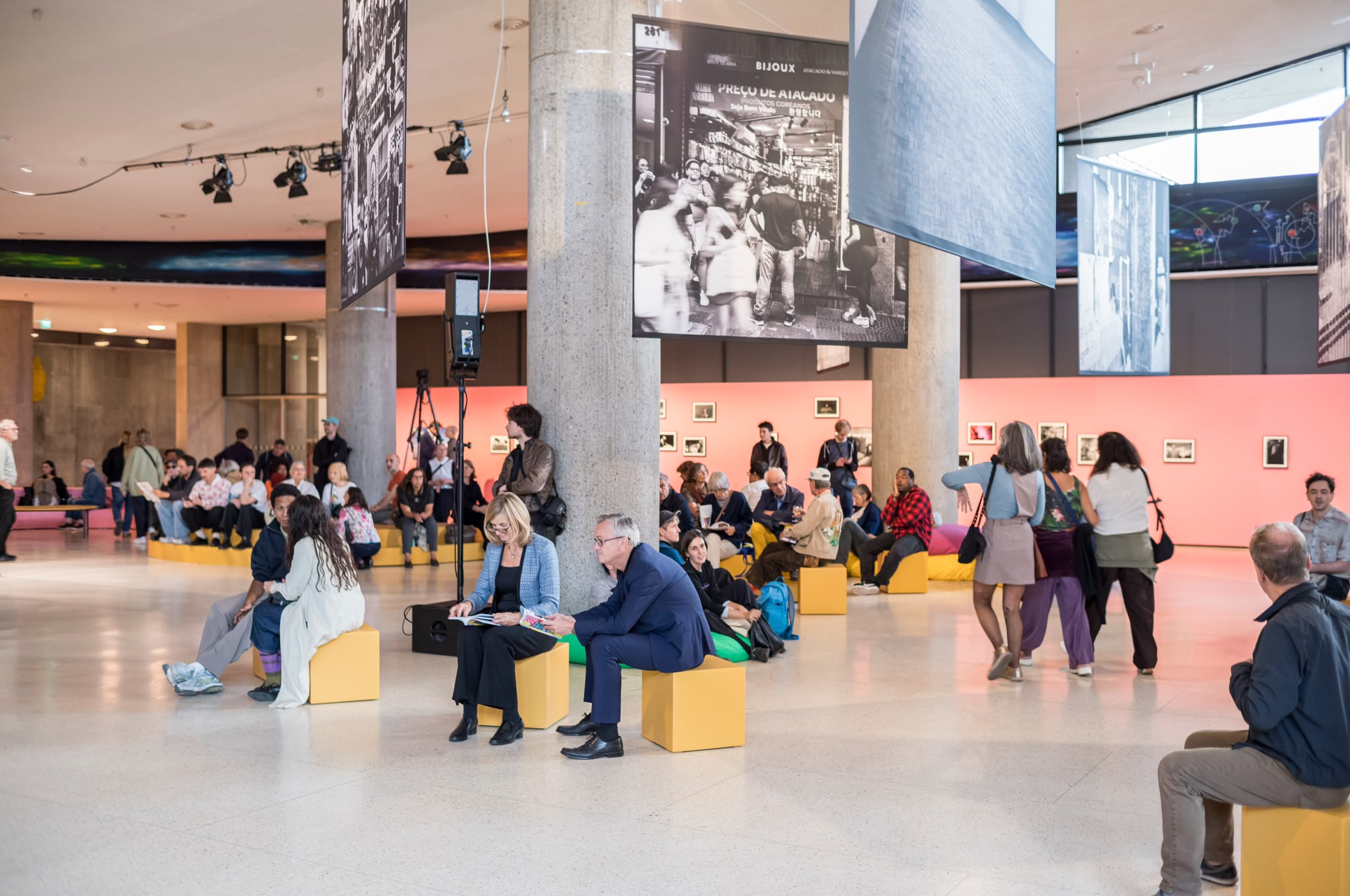
This practice takes a particular form with British-Nigerian photographer Akinbode Akinbiyi. His black and white photographs, printed on suspended fabrics, populate the Sylvia Wynter foyer with faces, movements, and ordinary scenes of São Paulo. Fragments of life captured without voyeurism or intrusion. One senses the time spent observing, the patience needed to approach the other without disturbing. Among these suspended presences, looking becomes a way of making space. This patience is often lacking in us. In our daily lives shaken by real and fake urgencies, we are sometimes too quick to respond to listen all the way through. And when it comes to defending financial interests, the refusal to make space for the other can take on otherwise devastating proportions.<\/p>
As soon as oil companies discover a deposit, the inhabited land becomes a resource to exploit. It is this extractivist logic that Brazilian artist Aline Baiana denounces in her documentary Ouro negro é a gente (“Black Gold is the People”). The film tells how, on Maré Island, in the Bay of All Saints in Brazil, oil extraction threatens, in the name of development, the ecosystems and ways of life of quilombola communities. Heirs to communities founded by people who fled slavery, these communities today defend their territories and traditions.<\/p>
Here and elsewhere, environmental injustice and social violence are often complicit. When water becomes unlivable, what remains of the lives it nourished? Delta-Delta: People’s Court I, an audiovisual installation by Forensic Architecture/Forensis, extends this inquiry by establishing links between colonial plunder and oil devastation. On the north facade of the HKW, facing the Spree and the Federal Chancellery, American artist Olu Oguibe, born in Nigeria, gives this violence the size of a question: “Do you have to take everything that belongs to the indigenous peoples?” This question follows us into our daily life. We know the price of the objects we purchase, but we often ignore the lives and lands devastated to produce them.<\/p>
 <\/p>
<\/p>
In the text accompanying the exhibition, the chief curator of this Biennial, Bonaventure Soh Bejeng Ndikung, echoes a question from Nigerian artist Leo Asemota: when we look in a mirror, who do we see? Only ourselves? Perhaps the stranger who arrives also holds up a mirror to us. Who do we become when the other, in search of refuge, calls for our hospitality? The rise of far-right extremism in several countries and the normalization of xenophobic discourse grant this question particular urgency.<\/p>
Nowadays, the migrant too often sees their dignity trampled and finds themselves summoned to answer for everything, from the lack of housing to the disappearing jobs. Even before they can tell their story, they are almost automatically assigned a role in the fears of others. Conjugating humanity then becomes a political question. Who do we accept to include in this “we” behind which so many borders rise?<\/p>
Through the works, I understand better what the estuary, at the heart of the curatorial thought, has to tell us. At the mouth of the river, fresh water meets salt water, and life finds its place in this mix. The currents clash, balances shift, and in this movement, coexistence is constructed without differences having to erase themselves. Perhaps we have something to learn from these waters: how to live together, allowing ourselves to be transformed by encounter, without renouncing what we are? Ndikung and Alya Sebti, curator of the Berlin edition, invite us to begin with listening. Among the fabrics, voices, canvases, and images, I find myself slowing down, paying attention to lives far removed from my own. It remains to carry this attention beyond the exhibition.<\/p>
What to do, then, every morning? I don’t know. Perhaps honor our encounters with others, let them finish their sentences, resist the urge to revert their accounts to our own, ask them what they need before deciding in their place… Certainly, these gestures will not suffice to repair devastated lands or remedy social injustices, but they will cultivate in us a faculty that the logics of devastation and hostility tend to abolish: recognizing the value of an existence that does not belong to us.<\/p>
From this magnificent Biennial, which runs until December 6, I left with this modest and difficult commitment: to create, in my days, a space where the other can enter without having to conform to me, nor I to them. Perhaps this is how the conjugation of the verb humanity begins.<\/p>
To go further:<\/p>
https:\/\/www.hkw.de\/en\/programme\/not-all-travellers-walk-roads-of-humanity-as-practice<\/a><\/p> https:\/\/36.bienal.org.br\/en\/itinerancias\/berlin\/<\/a><\/p>
