

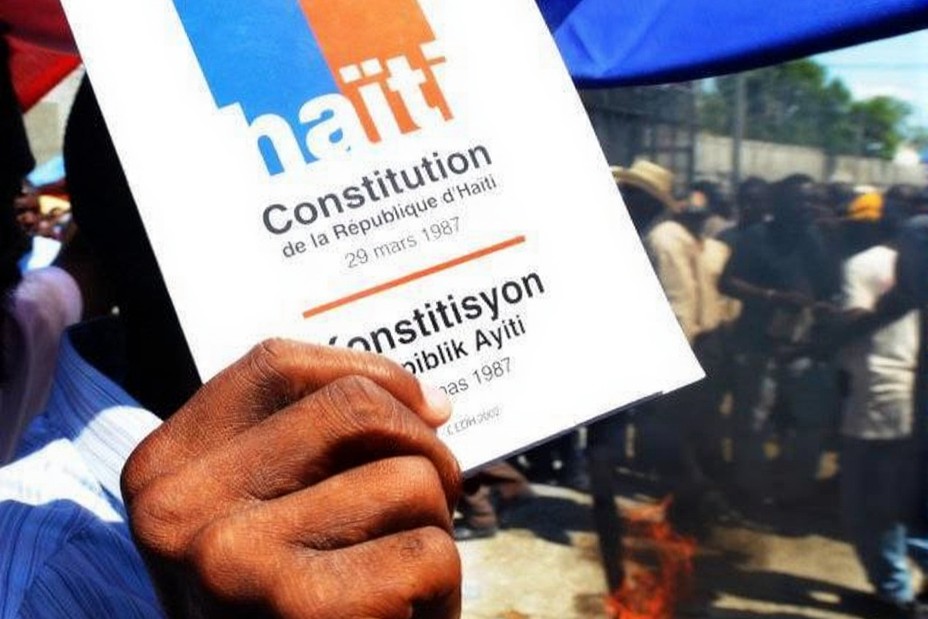
The structured argument for Haitian constitutional reform must be conceived as an instrument of national and geopolitical refoundation, capable of addressing the challenges of the 21st century and the new reality of global Haiti. It opts for a less constraining political system and reconciles the renewal of political personnel with our economic possibilities. The first principle of sovereignty recommends that elections be conducted solely and exclusively using domestic resources. This overhaul
must be articulated around the following main strategic axes:
1. The consecration of global Haiti
The 1987 constitution was written in a post-dictatorial climate of distrust, creating a rigid framework that effectively excludes Haitians living abroad. The 2026 World Cup demonstrated that the Haitian nation lives and thrives well beyond its physical borders.
The State must transition from a physical sovereignty to a transnational sovereignty. The reform must enshrine the principle of absolute and inalienable jus sanguinis. Haitian nationality must never be lost or suspended through the acquisition of another nationality.
The political objective is to create full citizenship for the diaspora (voting rights, eligibility for key political positions, dedicated parliamentary representation), which would transform yesterday's exile into a lever for investment and skills return.
2. The linguistic revolution.
The current official bilingualism (Creole/French) *maintains* a form of exclusion internally and isolates Haiti from its regional environment (Caribbean and Americas) dominated by English and Spanish.
Drawing inspiration from multilingual models like Switzerland, the new constitution must establish four official languages: Creole, French, English, and Spanish.
The functional hierarchy.
Creole is the foundation, the pivot of national identity, the language of instruction, and the language of legal authenticity (the Creole text prevails in case of interpretation disputes regarding laws).
The other languages (French, English, and Spanish) will be co-official languages.
They are strategic tools for economic integration (Caricom, OAS), access to cutting-edge technologies, and international diplomacy. The constitutional objective is to ensure mastery of these four languages through all competencies (reading, writing, speaking, and understanding) by the end of the classical education cycle.
3. Pedagogical sovereignty.
The Haitian educational system is alienating, outdated, archaic, drying, and dusty. The State has the obligation to educate citizens in the best possible way and to equip them usefully for the modern economy. The educational reform must not only bring us closer to our environment, our values, and our culture, but it must also help us discover the new assets of the modern world.
We must replace the least useful concepts that no longer have an impact in our society with more trending disciplines, such as digital sciences and AI, starting from the fundamental cycle to ensure the training of a diverse array of technicians capable of facing and mastering cutting-edge technology and emerging professions to develop the country and advocate for the right to educational and cultural self-determination.
4. The institutionalization of sports.
The new constitution must elevate sports to the rank of a national priority of public interest. Sports must no longer be considered a peripheral activity practiced only on a playground without any technical support but a classic subject in its own right, integrated into official curricula, with real coefficients and theoretical and practical exam programs.
The objective is to create constitutional pathways for sports-studies from primary classes to university, linking academic excellence to athletic performance to provide a social lift for youth and allow them to benefit from the privileges associated with this sector of activities on an international level.
Sports as a thriving global industry.
The sports industry has established itself as one of the most profitable, accessible, and dynamic sectors of the global economy. Once relegated to mere entertainment and physical well-being, it has transformed into a first-rate financial machine, with numerous specializations, trading hundreds of thousands of dollars each year.
This exponential growth relies on an interconnected ecosystem, blending live performances, media, technologies, and global marketing.
At the heart of this profitability lie television and digital broadcasting rights. Networks and streaming platforms are engaged in a relentless battle to acquire exclusive rights to major globally followed competitions. These events captivate thousands of viewers simultaneously, offering advertisers unique mass visibility in an otherwise highly fragmented media landscape.
Emerging jobs are born from sports.
The globalization of brands and sponsorship has reached unprecedented heights. Clubs and athletes are no longer mere sports entities, but global brands with high added value. Multinational companies invest colossal fortunes to associate their images with those of global stars or to place their logos on the jerseys of legendary teams. This phenomenon is accompanied by a colossal market for sports equipment, high-performance shoes, and merchandise that attract fans from all corners of the globe.
