

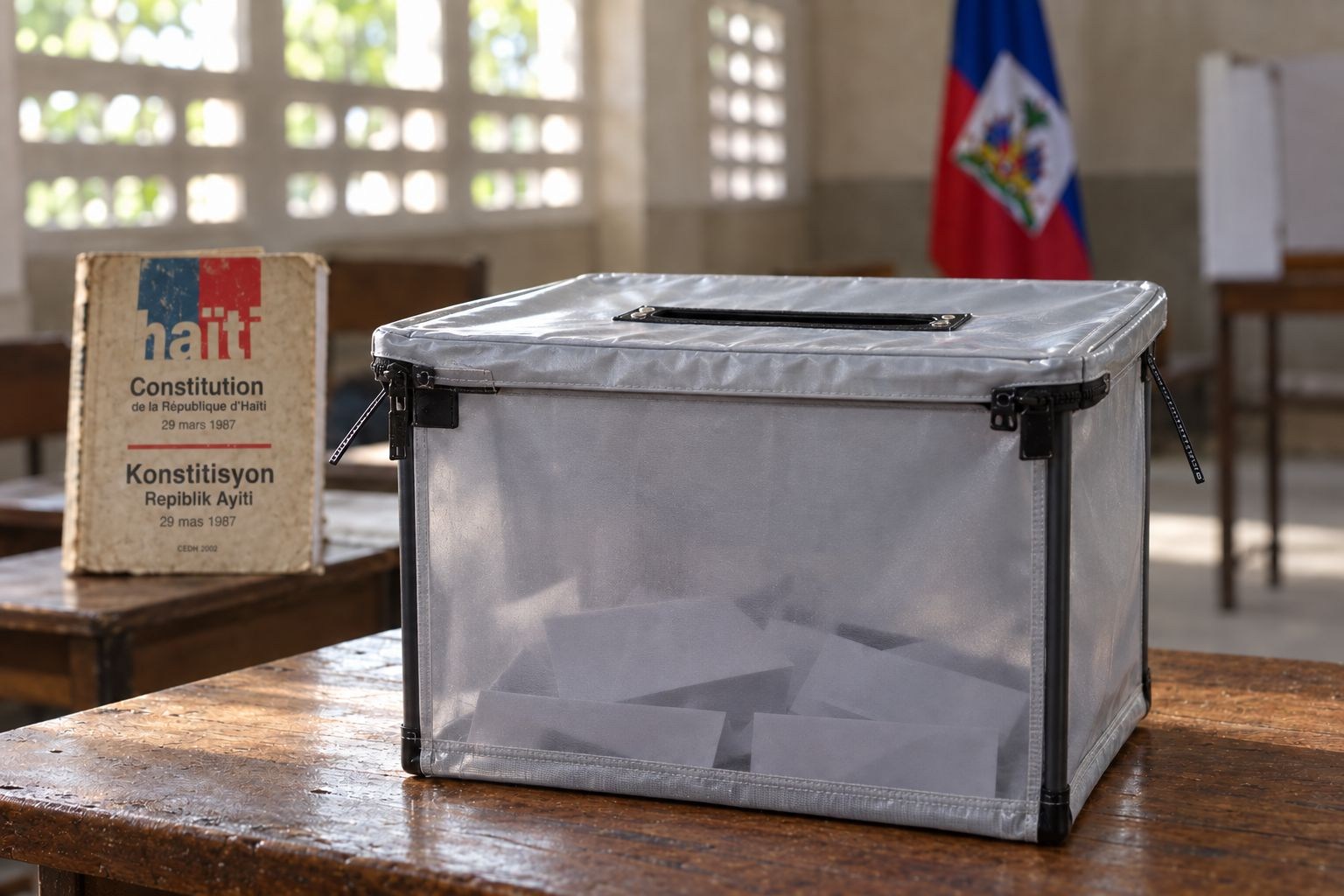
In my article Choosing Democracy: Ending Transition as a Regime of Chaos, I defended a simple idea: Haiti must move out of perpetual provisionality and finally give real chances to democratic institutions.<\/p>
This conviction remains. But it raises another question: what conditions must we build for democracy to actually function and, above all, endure in Haiti? <\/p>
Because organizing elections is not enough to build a democracy.<\/p>
Moreover, there is no universal democratic model that mechanically applies to all societies. Each people builds its democracy based on its history, political culture, institutions, and the social relations that structure its society. Haiti cannot escape this reality.<\/p>
A sustainable democracy cannot rest on exclusion.<\/p>
Our challenge is profound. We want to build an open democracy in a society that remains largely organized around limited access mechanisms.<\/p>
Since the formation of the Haitian state, no sustainable social compromise has truly allowed for the integration of elites and masses into a single national project. The personalization of power, the concentration of resources, and limited access to political and economic opportunities have kept a large part of the population on the margins of formal institutions, the productive economy, and real mechanisms of social mobility.<\/p>
When access to power, capital, education, jobs, justice, or markets hinges more on personal relationships, privileges, and power dynamics than on impersonal rules, democratic competition itself becomes fragile.<\/p>
Elections then risk becoming a struggle for control of the state and its resources rather than a competition between social projects. And when losing power means losing access to resources, privileges, or the protection offered by the state, accepting alternation becomes much more difficult.<\/p>
That’s why democracy cannot be merely electoral. It must become institutional, economic, and social.<\/p>
The Integrative Compromise: Establishing New Rules of the Game<\/p>
This is where the Integrative Compromise between elites and masses comes in.<\/p>
It is not about suspending democracy while waiting for Haiti to be ready to practice it, nor allowing a few elites to decide on behalf of the population. It is about reaching a sufficiently deep agreement on the fundamental rules of the game so that everyone can accept competition, but also its outcome.<\/p>
Politically, this requires the depersonalization of power, credible institutions, an independent judiciary, regular elections, and the acceptance of alternation.<\/p>
Economically, it means opening up opportunities, gradually reducing rents and privileges, and offering, in return, a stable and predictable environment conducive to investment, production, and wealth creation.<\/p>
Socially, the challenge is even greater: the masses cannot be only engaged at election time. They must become fully integrated citizens in the economy, education, social mobility, and opportunities.<\/p>
This is how we can gradually move from a social order of limited access to a social order of open access.<\/p>
And it is, in my view, in this space that democracy can truly take root.<\/p>
Building the Compromise through National Dialogue<\/p>
Such a compromise cannot be imposed. It must be built by the Nation.<\/p>
The process should begin with a democratically elected President, possessing the necessary legitimacy to initiate the process without seeking to control its conclusions.<\/p>
A national pre-consultation commission, mainly composed of nationally recognized experts for their competence, integrity, and independence, would prepare the conditions for the dialogue. A national dialogue commission would then be responsible for organizing a Sovereign National Conference, bringing together the main components of the Nation: political and economic actors, social organizations, unions, universities, local authorities, women, youth, civil society, media, moral and religious authorities, as well as the diaspora.<\/p>
We must be clear about our objective: this is not about creating a new transition.<\/p>
It is precisely the opposite.<\/p>
We must build rules and a consensus that are sufficiently strong so that future political crises can be resolved within institutions, without the country being condemned to revert to a new transition each time.<\/p>
Breaking with Impunity and Rebuilding Trust<\/p>
But no historical compromise will be durable if we refuse to face the issue of corruption and impunity.<\/p>
Hence the necessity of the Great Trial against Corruption and Impunity. Not an exceptional jurisdiction, let alone a witch hunt, but a national process of truth, investigation, and accountability, conducted in respect of the rule of law, the presumption of innocence, and the independence of justice.<\/p>
We must look to the past to establish accountability and break with impunity. But we must above all prevent the same practices from recurring. That’s why accountability must become, for the future, a permanent rule of governance.<\/p>
From the Integrative Compromise to National Recovery<\/p>
The consensus achieved through the Sovereign National Conference must lead to the Integrative Compromise. But it cannot remain a mere declaration of principles.<\/p>
It must translate into concrete commitments through the Socio-Economic Development Pact for Stability and Growth — PSEDSC, articulated around the three areas of national recovery: political, economic, and social.<\/p>
These three dimensions are inseparable. Without political stability and strong institutions, it will be difficult to sustainably attract investment. Without investment, production, and jobs, we cannot widen economic opportunities and foster the emergence of a larger middle class. And without education, social mobility, and economic autonomy, a large part of the population will remain too vulnerable to fully exercise their citizenship.<\/p>
Democratic consolidation thus becomes the result of a much broader process: stability allows for investment; investment promotes production and jobs; jobs open opportunities and facilitate social mobility; a more economically autonomous population can exercise its citizenship more freely.<\/p>
But this requires time.<\/p>
A sustainable democracy, like a modern economy or strong institutions, cannot be built in a single presidential term. The commitments resulting from the Integrative Compromise and formalized in the PSEDSC must therefore be embedded in a national recovery plan over twenty-five years, capable of ensuring continuity of major national priorities beyond governments.<\/p>
This does not mean at all that successive governments should apply the same program. Each government must retain the choices corresponding to the mandate received from citizens. This is precisely what democratic alternation is about.<\/p>
But changing government should no longer mean starting the country over from scratch.<\/p>
We must learn to build continuity in alternation.<\/p>
A Condition for Sustainable Democracy<\/p>
To say that the Integrative Compromise constitutes a condition for sustainable democracy does not mean, above all, that democracy must be postponed.<\/p>
Haiti must exit transition through elections and restore its constitutional institutions.<\/p>
But the next democratically elected power must understand that its responsibility does not stop at the acquisition of power. It must contribute to building the conditions that will finally allow democracy to endure.<\/p>
The proposed approach is therefore clear:<\/p>
Election and return to democratic legitimacy → National pre-consultation commission → National dialogue commission → Sovereign National Conference → Great Trial against Corruption and Impunity → Integrative Compromise → PSEDSC → Twenty-five-year national recovery plan → Permanent mechanism for monitoring, evaluation, and accountability.<\/p>
Choosing Democracy, Building Its Foundations<\/p>
Exiting transition is a necessity. Building the conditions that prevent its return is the real challenge.<\/p>
If we organize elections without changing the political, economic, and social relations that reproduce instability, we risk repeating the same cycle: elections, conflicts, institutional paralysis, crisis, rupture, transition, then new elections.<\/p>
We must break this cycle.<\/p>
The question is no longer just about how to organize the next elections. It is more fundamental: how to ensure that Haiti no longer needs a transition to resolve its political crises?<\/p>
This is perhaps where the true choice for democracy begins: when elites accept rules that limit their power, when the masses gain real access to opportunities and citizenship, when the state stops being loot and becomes an institution, and when alternation ceases to be a rupture and becomes the normal functioning of the Republic.<\/p>
Choosing democracy means exiting transition.<\/p>
Building the Integrative Compromise means creating the conditions to never return to it.<\/p>
